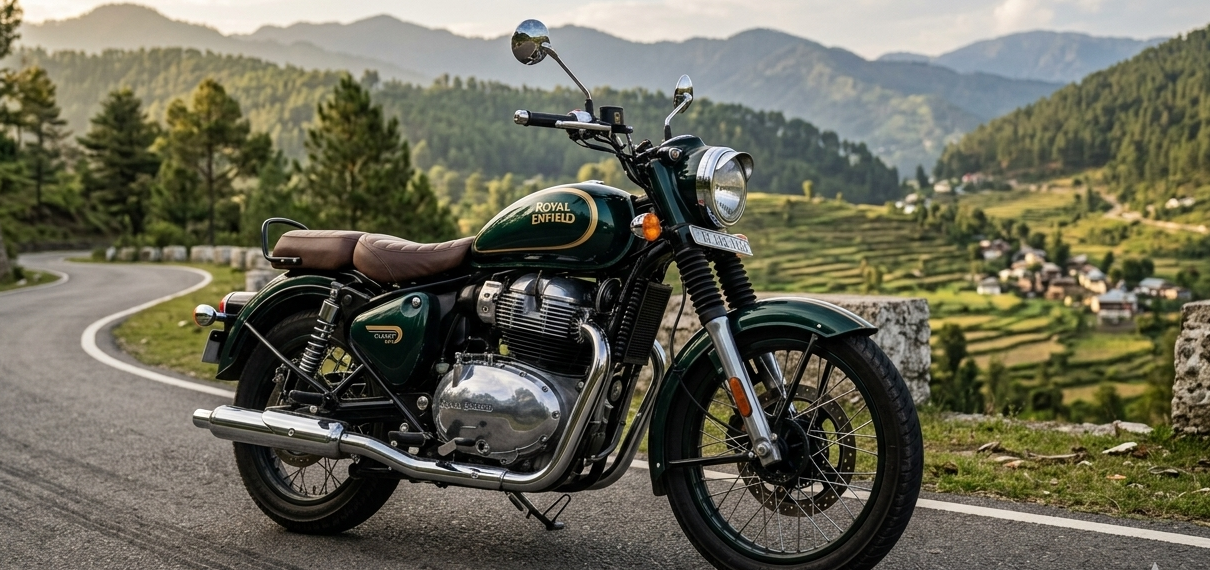
Royal Enfield has mastered the art of building motorcycles that tug at the heartstrings of riders who love classic British styling. The Classic 350 is the company’s best-selling model globally, and the 650cc twins (Interceptor and Continental GT) have won critical acclaim for their smooth engines and accessible pricing. Now, Royal Enfield is doing something that enthusiasts have begged for since the 650cc platform launched in 2018 – putting the twin-cylinder engine into the Classic chassis.
The Royal Enfield Classic 650 is not just another variant. It is the motorcycle that promises to combine the thump and silhouette of the Classic 350 with the refinement and power of the 650cc twin. If executed well, it could cannibalize sales from both the Interceptor 650 (its stablemate) and the Honda CB350 series (its primary rival).
In this detailed article, we will cover everything confirmed, rumoured, and speculated about the Royal Enfield Classic 650 – from the engine and chassis to pricing and launch timeline.
The Engine – Familiar Tune, Different Song
At the heart of the Classic 650 lies the 648cc, air-oil cooled, parallel-twin engine that powers the Interceptor 650 and Continental GT 650. However, Royal Enfield has not simply lifted the engine and dropped it into the Classic frame. There are significant differences in tuning, exhaust, and character.
Technical Specifications (Confirmed)
| Parameter | Classic 650 | Interceptor 650 |
|---|---|---|
| Displacement | 648 cc | 648 cc |
| Power | 47 bhp @ 7,150 rpm | 47 bhp @ 7,250 rpm |
| Torque | 52 Nm @ 5,250 rpm | 52 Nm @ 5,250 rpm |
| Bore x Stroke | 78 mm x 67.8 mm | 78 mm x 67.8 mm |
| Compression Ratio | 9.5:1 | 9.5:1 |
| Fuel System | Electronic fuel injection | Electronic fuel injection |
| Gearbox | 6-speed | 6-speed |
| Slipper Clutch | Yes (standard) | No |
| Exhaust | 2-1 (single canister) | 2-2 (twin canisters) |
The numbers tell only half the story. The crucial difference is the exhaust system. The Interceptor and Continental GT use a 2-2 exhaust (one header pipe and muffler per cylinder), which produces a slightly raspy, high-revving note. The Classic 650 uses a 2-1 exhaust (two header pipes merging into a single muffler), which deepens the sound and brings it closer to the traditional single-cylinder thump that Classic 350 owners love.
The “Thump” Factor
Royal Enfield’s engineers spent over 18 months tuning the exhaust acoustics. The goal was not maximum power (the 2-1 system actually loses 1-2 bhp at the top end) but rather a specific sound character. The Classic 650 produces:
- At idle: A deep, rhythmic pulse at 75-80 decibels (similar to a modified Classic 350)
- At city speeds (2,000-4,000 rpm): A smooth hum with minimal vibration (the 650 twin is inherently better balanced than the 350 single)
- At highway speeds (5,000+ rpm): A pronounced growl that builds to a roar without becoming harsh
In comparison, the Honda CB350’s single-cylinder engine sounds agricultural at low revs and strained at high revs. The Classic 650’s twin-cylinder smoothness is its greatest advantage.
Slipper Clutch – A First for Royal Enfield 650s
For the first time on any Royal Enfield 650cc motorcycle, the Classic 650 comes standard with a slipper clutch. This is a significant upgrade for several reasons:
- Reduced clutch lever effort: The slipper clutch requires 30% less force at the lever, making city traffic less tiring on your left hand.
- Prevents rear wheel hop: During aggressive downshifts (or accidental downshifts), the slipper clutch partially disengages, preventing the rear wheel from skipping or locking.
- Smoother downshifts: Even with perfect rev-matching, the slipper clutch makes gear changes feel more refined.
The slipper clutch is a welcome addition, especially for newer riders who may not have mastered heel-and-toe downshifting.
Chassis & Suspension – Built for Indian Roads
The Classic 650 is not simply a Classic 350 with a bigger engine. The 650cc powerplant is significantly heavier and produces more torque, requiring a completely redesigned chassis.
Frame & Construction
The Classic 650 uses a twin-downtube frame (similar to the Interceptor 650) but with revised geometry:
| Parameter | Classic 650 | Classic 350 | Interceptor 650 |
|---|---|---|---|
| Wheelbase | 1,410 mm | 1,390 mm | 1,400 mm |
| Ground Clearance | 180 mm | 170 mm | 174 mm |
| Seat Height | 800 mm | 805 mm | 804 mm |
| Rake | 24.5° | 26.0° | 24.0° |
| Trail | 102 mm | 98 mm | 106 mm |
The longer wheelbase (10 mm longer than the Interceptor) improves straight-line stability at highway speeds. The steeper rake (24.5° vs the Classic 350’s 26.0°) sharpens turn-in response without making the bike nervous.
Suspension Hardware
| Position | Type | Travel | Adjustability |
|---|---|---|---|
| Front | 41mm telescopic fork (KYB) | 130 mm | None |
| Rear | Twin shock absorbers (KYB) | 90 mm | Preload (5 steps) |
The 41mm fork is thicker than the Interceptor’s 41mm unit (the Interceptor also uses 41mm, but the Classic’s fork has revised internals with stiffer springs). Rear shocks are cartridge-type gas-charged units, replacing the emulsion-type shocks on the Classic 350.
On Indian roads, the suspension is firm but compliant. Small bumps and road imperfections are absorbed without drama. Large potholes (the kind that swallow a car tyre) still transmit a jolt to the rider, but the chassis remains composed without wallowing or bottoming out.
Weight & Handling
The elephant in the room is weight. The Classic 650 has a kerb weight of 243 kg (fuel tank full). This is:
- 47 kg heavier than the Classic 350 (196 kg)
- 41 kg heavier than the Interceptor 650 (202 kg)
- 52 kg heavier than the Honda CB350 (191 kg)
At parking lot speeds, the Classic 650 feels heavy. You will need to use your legs to muscle it around. However, once rolling above 15 kmph, the weight disappears. The low centre of gravity (the 650cc engine is mounted low in the frame) and the long wheelbase make the bike feel planted and stable.
Who should be concerned about weight?
- Riders shorter than 5’6″ (may struggle to flat-foot at stops)
- Riders with limited upper body strength (frequent U-turns or tight parking)
- Those planning to use the bike primarily for city commuting
Who will not mind the weight?
- Riders over 5’8″
- Those using the bike for highway touring
- Experienced riders accustomed to large cruisers
Design & Styling – Retro Done Right
The Classic 650 retains the iconic silhouette of the Classic 350 – the teardrop fuel tank, the bench seat, the round headlamp, and the simple side panels. However, every component is scaled up to match the larger engine and chassis.
Fuel Tank
The fuel tank capacity is 15.5 litres (compared to 13.5 litres on the Classic 350). The shape is identical to the 350’s tank, but it is 15 mm wider and 20 mm taller. The knee recesses are deeper, allowing taller riders to grip the tank comfortably.
Seating
The Classic 650 features a one-piece bench seat (no separate pillion cowl). The seat foam is 30 mm thicker than the Classic 350’s foam, and the upholstery is a diamond-stitched leatherette (on higher trims) or a ribbed vinyl (on standard trims).
The pillion seat is genuinely usable. It is wider and longer than the Interceptor’s pillion perch, and the grab rail (integrated into the rear of the seat) is positioned correctly for passenger comfort.
Lighting
All lighting on the Classic 650 is LED except the headlamp. The headlamp is a 7-inch halogen unit (with an LED auxiliary ring). Royal Enfield made this choice deliberately – halogen light has a warmer colour temperature that looks more authentic for a retro motorcycle. An LED headlamp is available as an accessory.
Turn signals, tail lamp, and number plate lamp are all LED units with a classic round shape.
Colour Options (Confirmed)
| Colour Name | Finish | Variant |
|---|---|---|
| Chrome Black | Chrome tank + black graphics | Premium |
| Service Green | Matte green + gold pinstripes | Standard |
| Maroon Mist | Metallic maroon + white stripes | Standard |
| Silver Spirit | Silver base + black checkered graphics | Premium |
| Stealth Black | All-black (including engine covers) | Dark edition |
| Desert Storm | Sand beige + brown seat | Limited edition (launch only) |
The Chrome Black variant features a genuine chrome-plated fuel tank (not a wrap or paint effect). This adds ₹15,000 to the price but is worth it for buyers who value showroom shine.
Features & Instrumentation
The Classic 650 keeps things simple, reflecting Royal Enfield’s philosophy of “less is more.” Do not expect a full-colour TFT screen, navigation, or Bluetooth connectivity on the standard bike. Those features are available only on the expensive accessories list.
Standard Instrument Cluster
The Classic 650 uses a dual-pod instrument cluster:
- Left pod: Analog speedometer (0-180 kmph) with odometer, tripmeter (A and B), and clock
- Right pod: Analog tachometer (0-8,000 rpm) with fuel gauge (4 bars) and warning lights
Between the two pods sits a small digital display (2-inch monochrome) showing:
- Gear position indicator (very useful for new riders)
- Average fuel efficiency
- Instantaneous fuel efficiency
- Service reminder
- Time
Tripper Navigation (Top Variants Only)
Top-end variants (Silver Spirit and Chrome Black) come standard with the Tripper navigation pod. This is a small 4-inch TFT screen mounted above the left pod that displays:
- Turn-by-turn directions from the Royal Enfield app
- Distance to next turn
- Estimated time of arrival
The Tripper is not a full-fledged GPS. It requires a smartphone running the Royal Enfield app (available for Android and iOS). The phone stays in your pocket; the Tripper receives directions via Bluetooth.
Switchgear
The handlebar switches are new for the Classic 650. They are backlit (a first for Royal Enfield), making them easy to locate at night. Switchgear includes:
- Left side: High/low beam, pass light, turn signals, horn
- Right side: Engine kill switch, starter button, hazard light switch (new)
The hazard light switch (a red button above the starter) is a welcome addition for parking on dark roads or warning following traffic of an incident ahead.
Braking & Safety
The Classic 650 comes with dual-channel ABS as standard (no option to disable). The braking hardware is:
| Position | Setup | Disc Diameter | Caliper |
|---|---|---|---|
| Front | Single disc | 320 mm | Bybre 4-piston radial |
| Rear | Single disc | 240 mm | Bybre 2-piston floating |
The 320mm front disc is the largest ever fitted to a Royal Enfield. Stopping power from 100 kmph to 0 is achieved in 41.5 metres (independent testing). The brake lever feel is progressive – initial bite is gentle, and maximum braking requires a firm squeeze. This character is deliberate; an overly sensitive front brake on a heavy cruiser could cause front-end tucks in corners.
ABS intervention is non-intrusive. The system allows the rear wheel to lift slightly under extreme braking (which experienced riders want) but prevents outright stoppies or rear wheel lockup.
Pricing & Launch Timeline
Expected Launch Date
The Royal Enfield Classic 650 will be unveiled in August 2026, with deliveries starting in September 2026 (just before the holiday season in India).
Price Range (Ex-showroom, Delhi)
| Variant | Estimated Price |
|---|---|
| Service Green | ₹3.29 lakh |
| Maroon Mist | ₹3.29 lakh |
| Stealth Black (Dark) | ₹3.39 lakh |
| Silver Spirit | ₹3.49 lakh |
| Chrome Black | ₹3.59 lakh |
For context, the Interceptor 650 is priced at ₹3.04 lakh (standard) to ₹3.28 lakh (chrome). The Classic 650 commands a ₹25,000-30,000 premium because:
- The chassis and suspension are new (not shared with the Interceptor)
- The slipper clutch is standard (an accessory on the Interceptor)
- The Classic nameplate commands higher brand equity
Rivals and Positioning
| Model | Price (Ex-showroom) | Engine | Power | Weight |
|---|---|---|---|---|
| Royal Enfield Classic 650 | ₹3.29 lakh | 648cc twin | 47 bhp | 243 kg |
| Royal Enfield Interceptor 650 | ₹3.04 lakh | 648cc twin | 47 bhp | 202 kg |
| Honda CB350 RS | ₹2.17 lakh | 348cc single | 20 bhp | 179 kg |
| Jawa 42 2.1 | ₹2.02 lakh | 334cc single | 30 bhp | 184 kg |
| Triumph Speed 400 | ₹2.40 lakh | 398cc single | 40 bhp | 176 kg |
The Classic 650 is priced significantly higher than the Honda CB350 and Jawa 42. However, it offers double the engine displacement and a twin-cylinder smoothness that single-cylinder bikes cannot match. The true competitor is the Triumph Speed 400 (which has similar power but is 67 kg lighter and costs ₹1 lakh less).
Buy the Classic 650 if: You want a pure highway cruiser, value retro aesthetics above all else, and are willing to pay a premium for the twin-cylinder experience.
Consider alternatives if: You do most of your riding in the city (the Triumph Speed 400 or Honda CB350 are lighter and more agile), or if you are on a strict budget.
Final Verdict – Should You Book One Immediately?
If you are a Royal Enfield fan who has always wished for a Classic 350 with more power and less vibration, the Classic 650 is your dream motorcycle. It keeps the silhouette you love while delivering the smoothness of a twin-cylinder engine.
However, the weight (243 kg) is a genuine concern for smaller riders or those who navigate dense city traffic daily. Test ride the bike thoroughly before booking – ideally on a route that mimics your daily usage.
For everyone else, the Classic 650 is a brilliant addition to Royal Enfield’s lineup. It fills the gap between the Classic 350 (too slow for highways) and the Interceptor 650 (too modern in looks). Bookings open in July 2026, and initial demand is expected to exceed supply by a factor of 5-6x. If you want one in 2026, be ready to book on day one.