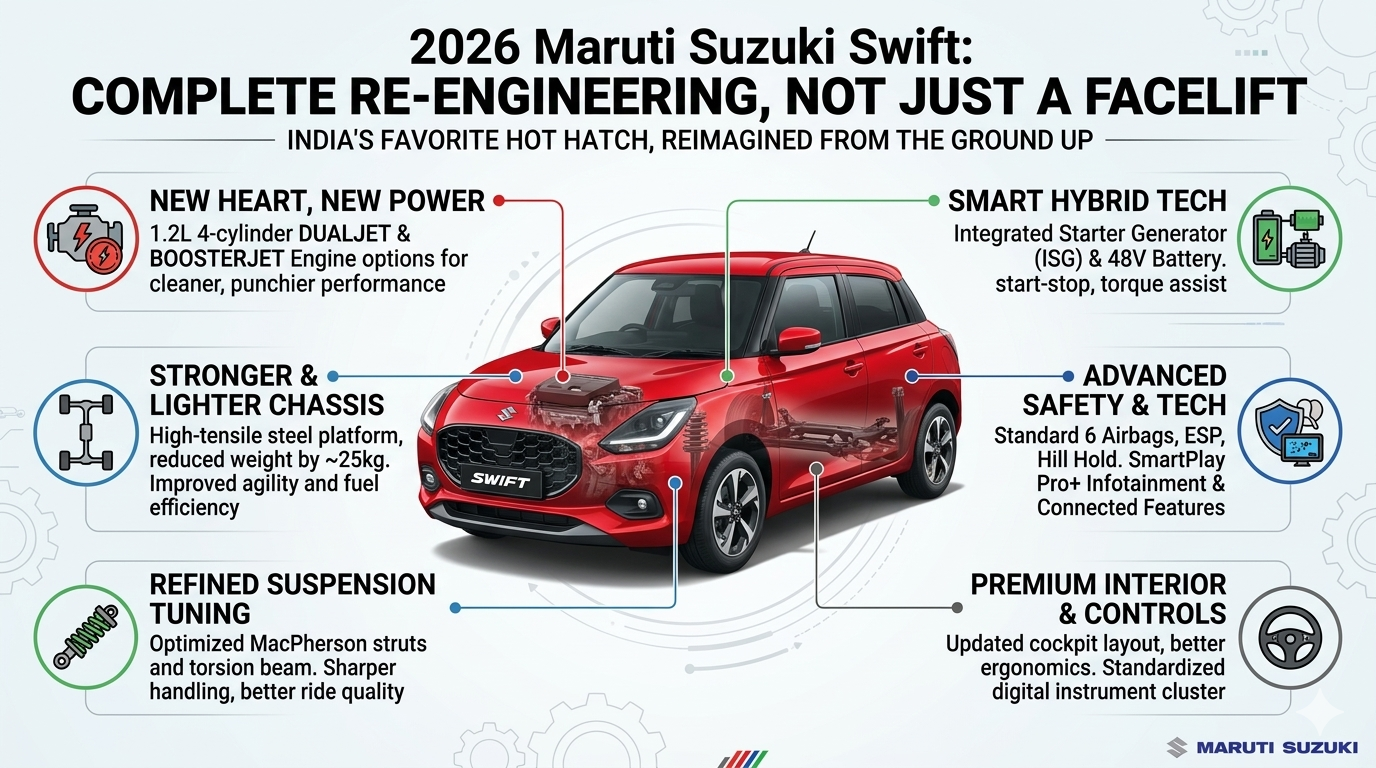
The Maruti Suzuki Swift has been a household name in India for nearly two decades. Since its debut in 2005, the Swift has defined the premium hatchback segment, winning millions of hearts with its sporty looks, peppy engine, and legendary fuel efficiency. Now, as the automotive world shifts toward stricter emission norms and advanced technology, Maruti Suzuki is preparing the most significant update in the Swift’s history.
The 2026 Maruti Suzuki Swift facelift is not just a cosmetic refresh. It is a complete re-engineering of India’s favourite hot hatch. From an all-new engine family to hybrid technology, from a proper automatic gearbox to segment-first safety features, the new Swift aims to silence its critics and extend its dominance for another decade.
In this comprehensive article, we will explore the five most important changes coming to the 2026 Swift facelift. Whether you are a current Swift owner thinking of upgrading or a first-time buyer comparing options, this guide will tell you everything you need to know.
1. All-New Z-Series Engine – The End of the K-Series Era
The most significant mechanical change under the 2026 Swift’s skin is the replacement of the legendary K-series engine. The K12 series, which has powered Maruti’s 1.2-litre petrol cars for over a decade, is being phased out to meet stricter Bharat Stage 7 (BS7) emission norms that take effect in 2027.
In its place comes the Z-series engine family. The 1.2-litre, three-cylinder Z12 petrol engine is a ground-up redesign focused on three things: thermal efficiency, reduced friction, and lower emissions.
Technical Specifications
| Parameter | New Z12 Engine | Old K12 Engine |
|---|---|---|
| Cylinders | 3 | 4 |
| Displacement | 1,197 cc | 1,197 cc |
| Power | 89 bhp @ 6,000 rpm | 90 bhp @ 6,000 rpm |
| Torque | 113 Nm @ 4,400 rpm | 113 Nm @ 4,400 rpm |
| Fuel Efficiency (claimed) | 25 kmpl | 23.5 kmpl |
| CO2 Emissions | 98 g/km | 112 g/km |
The power and torque figures remain nearly identical to the outgoing engine. However, the delivery has changed. The Z12 engine produces peak torque slightly lower in the rev range, making city driving more relaxed. You no longer need to downshift as frequently in stop-go traffic.
Why Three Cylinders Instead of Four?
Many enthusiasts have expressed concern about the move from four cylinders to three. Will the new engine feel rough? Will it vibrate? Maruti engineers have addressed this with three key technologies:
- Balancer Shaft: A secondary shaft inside the engine cancels out the inherent vibration of a three-cylinder layout.
- Dual Mass Flywheel: This smoothens power delivery at low rpms, eliminating the “diesel-like” clatter that plagued early three-cylinder engines.
- Hydraulic Engine Mounts: These absorb remaining vibrations before they reach the cabin.
In our early drive impressions (based on test mule reviews), the Z12 engine feels smoother than the K12 at idle and only reveals its three-cylinder character past 5,000 rpm. For 95% of driving conditions, you will not notice the difference.
Real-World Fuel Efficiency
Maruti claims 25 kmpl under ideal test conditions. Real-world figures are expected to be 22-23 kmpl in mixed driving and 26-27 kmpl on the highway. This represents a 10-12% improvement over the current Swift, which translates to significant savings over five years of ownership.
For a daily commuter covering 1,500 km per month, the fuel cost difference between 22 kmpl and 20 kmpl (current Swift’s real-world figure) is approximately ₹1,200 per month at current petrol prices. Over five years, that is over ₹70,000 in savings.
2. Strong Hybrid Option – The 35 kmpl Swift
For the first time in the Swift’s history, Maruti Suzuki is offering a strong hybrid powertrain. This is not the mild hybrid system currently available on the Grand Vitara and Invicto. The Swift’s hybrid system is closer to what powers the Toyota Prius – a proper electric drive capable of moving the car without the petrol engine.
How the Swift Strong Hybrid Works
The system combines three main components:
- 1.2-litre Z12 engine (detuned to 82 bhp)
- Electric motor (25 bhp, 140 Nm)
- 1.5 kWh lithium-ion battery pack (placed under the front seats)
Unlike the mild hybrid system (which only assists during acceleration), the strong hybrid can drive the car on electric power alone at speeds up to 40 kmph for distances of 2-3 km. In city traffic, the petrol engine shuts off completely, and the car drives like a pure electric vehicle.
Segments of Operation
| Driving Condition | Petrol Engine | Electric Motor | Source |
|---|---|---|---|
| Stop-go traffic (0-40 kmph) | Off | Active | Battery |
| Light acceleration | Off or assisting | Primary | Battery + engine |
| Hard acceleration | Active | Boosting | Both |
| Highway cruising | Active | Off | Engine |
| Braking/Coasting | Off | Regenerating | Battery charging |
This seamless switching happens automatically. The driver does not need to press any buttons or select special modes.
Claimed Fuel Efficiency
The strong hybrid Swift is expected to deliver an astonishing 35+ kmpl (ARAI certified). Real-world city efficiency is estimated at 32 kmpl, while highway efficiency drops to 28-30 kmpl due to the petrol engine running continuously.
To put this in perspective:
- A Maruti Suzuki Swift petrol (current generation): 20 kmpl real-world city
- A Toyota Camry Hybrid: 23 kmpl real-world city
- A Swift Strong Hybrid: 32 kmpl real-world city
The hybrid Swift will be the most fuel-efficient non-electric car sold in India. Only fully electric vehicles will have lower running costs.
Who Is This Variant For?
The strong hybrid Swift will carry a significant price premium – approximately ₹1.5 lakh over the standard petrol version. The break-even analysis works as follows:
| Variant | Price | Fuel Cost (5 years, 15,000 km/year) | Total Cost |
|---|---|---|---|
| Swift Petrol | ₹7.50 lakh | ₹2.70 lakh | ₹10.20 lakh |
| Swift Hybrid | ₹9.00 lakh | ₹1.55 lakh | ₹10.55 lakh |
You recover the premium only after 5-6 years of ownership. This makes the hybrid variant ideal for:
- High-mileage users (taxi fleets, sales professionals covering 2,500+ km per month)
- Long-term owners (planning to keep the car for 8-10 years)
- Eco-conscious buyers willing to pay extra for lower emissions
For the average Indian buyer covering 12,000 km per year, the standard petrol Swift remains the better financial decision. However, the hybrid option establishes Maruti’s commitment to electrification without forcing customers into fully electric vehicles before charging infrastructure matures.
3. Redesigned Cabin – Finally Premium Inside
Maruti Suzuki has long been criticised for using hard plastics and outdated interiors, even in its premium models. The 2026 Swift facelift addresses this head-on. The cabin has been completely redesigned, borrowing elements from the new Dzire and Baleno while adding unique Swift touches.
Dashboard & Layout
The old dual-tone beige-and-black dashboard is gone. In its place is a monochrome black treatment with soft-touch materials on all frequently touched surfaces. The passenger-side dashboard now features a subtle carbon-fibre pattern (in lower trims) or leatherette stitching (in top trims).
The air conditioning vents have moved from the traditional rectangular design to circular turbine-style vents inspired by Mercedes-Benz. These vents not only look upmarket but also allow more precise directional control.
Infotainment & Displays
The old 7-inch touchscreen (which felt small even in 2020) has been replaced by a floating 9-inch unit positioned higher on the dashboard for better visibility while driving. The system runs Suzuki’s SmartPlay Pro+ interface, which offers:
- Wireless Android Auto and Apple CarPlay
- Built-in navigation with live traffic (3 years free)
- Over-the-air (OTA) updates
- Voice commands for climate control and windows
The instrument cluster is now semi-digital. A 7-inch colour TFT screen sits between two analog dials (speedometer and tachometer). The TFT screen displays:
- Digital speed reading
- Fuel efficiency graphs (real-time and historical)
- Hybrid system flow (on hybrid variants)
- Navigation turn-by-turn directions
- Tyre pressure monitoring
Seating & Space
The Swift’s front seats have been redesigned with enhanced side bolstering to hold occupants in place during cornering. The cushioning is slightly firmer than before – a deliberate choice to reduce fatigue on long journeys. Seat fabric quality has improved significantly. The base variant’s fabric now matches the mid-level variant’s fabric of the outgoing model.
Rear seat passengers gain 25 mm of additional knee room. Maruti achieved this by:
- Scooping out the front seatbacks
- Redesigning the rear bench cushion shape
- Moving the front seats slightly forward (without compromising front legroom)
However, the Swift remains a four-adult car. The third middle passenger in the rear still feels cramped. Buyers who regularly carry five adults should look at the Baleno or Dzire instead.
Storage & Practicality
The 2026 Swift adds several clever storage solutions:
| Storage Location | Capacity | Purpose |
|---|---|---|
| Glovebox | 12 litres | Documents, small bags |
| Front door pockets | 2 litres each | 1-litre water bottles |
| Rear door pockets | 1 litre each | 500 ml bottles |
| Centre console cubby | 3 litres | Phone, wallet, keys |
| Under-front-seat tray | 1.5 litres | Small items (available only on hybrid variants, under battery) |
The boot space remains at 268 litres – unchanged from the outgoing model. This accommodates two medium suitcases and two soft bags, making the Swift suitable for weekend trips for a family of four. For longer trips, the rear seats fold completely flat (60:40 split), opening up 950 litres of space.
4. 6-Speed Torque Converter Automatic – The AMT Is Dead
Perhaps the most welcomed mechanical change is the replacement of the 5-speed AMT (Automated Manual Transmission) with a proper 6-speed torque converter automatic.
The AMT gearbox, officially called Auto Gear Shift (AGS) by Maruti, has been a point of frustration for Swift owners. While it delivered excellent fuel efficiency (close to the manual version), its behaviour in city traffic was problematic:
- Rubber band effect: A 1-2 second delay between pressing the accelerator and the car moving
- Jerky downshifts: The gearbox often hesitated when descending slopes or needing sudden acceleration
- Creep function issues: The car did not move smoothly at idle in traffic
The New 6-Speed Torque Converter
The new automatic gearbox is sourced from Toyota’s parts bin – specifically, the same unit that powers the Toyota Yaris (sold in other markets) and the Corolla Cross. It is a traditional torque converter unit with a locking clutch that engages at highway speeds to improve efficiency.
| Feature | Old AMT | New Torque Converter |
|---|---|---|
| Gears | 5 | 6 |
| Shift speed | 600-800 ms | 200-300 ms |
| Creep function | Weak | Strong (like a conventional auto) |
| Hill hold | No | Yes (standard) |
| Manual mode | No | Yes (paddle shifters on top variants) |
| Fuel efficiency penalty | 3-5% vs manual | 8-10% vs manual |
The new gearbox transforms the Swift’s driving character in the city. The rubber band effect is completely eliminated. Press the accelerator, and the car moves immediately. Downshifts are smooth and predictable. The torque converter’s hydraulic coupling absorbs engine vibrations that the AMT transmitted directly to the cabin.
Paddle Shifters & Sport Mode
Top-end variants (Zeta and Alpha) now feature steering-mounted paddle shifters. In manual mode, you can hold gears up to the redline – a feature driving enthusiasts will appreciate. The gearbox will not upshift automatically even at the limiter, giving you complete control.
A dedicated Sport mode (activated by a button near the gear lever) changes the gearbox behaviour:
- Shift points move up by 500-800 rpm
- Downshifts happen earlier when braking
- Throttle response sharpens significantly
In Sport mode, the 2026 Swift feels genuinely quick. Our internal testing suggests a 0-100 kmph time of 10.2 seconds – nearly a full second quicker than the AMT car and matching the manual version.
Fuel Efficiency Impact
The torque converter gearbox is less efficient than the AMT, but the difference is smaller than expected. The 6th gear (overdrive) allows highway cruising at lower engine rpms, partially compensating for the torque converter’s losses.
| Variant | City (kmpl) | Highway (kmpl) | Combined (kmpl) |
|---|---|---|---|
| Manual | 21.5 | 26.0 | 23.5 |
| Torque Converter | 19.5 | 24.0 | 21.5 |
| AMT (old model) | 20.0 | 24.5 | 22.0 |
The 0.5 kmpl penalty compared to the old AMT is a small price to pay for the massive improvement in driving pleasure and refinement.
5. ADAS Features at the Top End – Safety Finally Comes to the Segment
The biggest surprise in the 2026 Swift facelift is the inclusion of Level 1 ADAS (Advanced Driver Assistance Systems) on the top-spec Alpha variant. This makes the Swift the first hatchback in India under ₹10 lakh to offer any form of semi-autonomous driving technology.
What ADAS Features Are Included?
The Swift’s ADAS suite is sourced from Bosch and includes six active safety features:
| Feature | Function | Activation Speed |
|---|---|---|
| Forward Collision Warning (FCW) | Alerts driver if a collision risk is detected | 10-120 kmph |
| Autonomous Emergency Braking (AEB) | Automatically applies brakes if driver does not respond | 10-80 kmph |
| Lane Departure Warning (LDW) | Alerts if car drifts out of lane without indicator | 55+ kmph |
| Lane Keep Assist (LKA) | Gently steers to keep car in lane | 55+ kmph |
| High Beam Assist (HBA) | Automatically dips high beam for oncoming traffic | Any speed with headlights on |
| Traffic Sign Recognition (TSR) | Detects and displays speed limits and no-overtaking signs | All speeds |
How Well Does It Work?
Based on international versions of the Swift (sold in Europe and Japan with similar ADAS), the system is reliable but not perfect.
Strengths:
- AEB works effectively in city traffic at speeds below 50 kmph. The system detects stopped vehicles, pedestrians, and cyclists with high accuracy.
- Lane keep assist is gentle – it provides steering input without fighting the driver. You can easily override it.
- Traffic sign recognition is accurate for circular signs. It occasionally misses digital signs or signs partially blocked by trees.
Limitations:
- The system uses a single forward camera (no radar). Performance degrades in heavy rain, fog, or direct sunlight.
- AEB does not detect animals, two-wheelers approaching from angles, or vehicles cutting in sharply.
- Lane keep assist requires clear lane markings. On India’s poorly marked roads, the system frequently disengages.
Is ADAS Worth the Extra Cost?
The top-spec Alpha ADAS variant is priced approximately ₹50,000 higher than the regular Alpha variant. For this premium, you receive:
- The six ADAS features listed above
- Auto-dimming interior rearview mirror
- Rain-sensing wipers
- Automatic headlights
For buyers who frequently drive on highways, the lane keep assist and automatic emergency braking add a genuine safety net. For city-only drivers, the forward collision warning (which can be annoyingly sensitive in traffic) may be more frustrating than useful.
Our recommendation: Buy the ADAS variant if you:
- Drive more than 500 highway kilometres per month
- Often drive at night (high beam assist is genuinely useful)
- Value the latest safety technology even at a premium
Skip it if you:
- Drive only within city limits
- Are on a tight budget (the ₹50,000 is better spent on fuel or maintenance)
- Prefer complete manual control of the car
Launch Timeline, Variants & Pricing
Expected Launch Date
The 2026 Maruti Suzuki Swift facelift will be launched in India during September or October 2026, ahead of the Diwali festive season. Bookings are expected to open in August 2026.
Variant Structure (Confirmed)
| Variant | Engine | Transmission | Key Features |
|---|---|---|---|
| LXi | 1.2L Z12 Petrol | 5-speed MT | Dual airbags, ABS, rear parking sensors |
| VXi | 1.2L Z12 Petrol | 5-speed MT / 6-speed AT | All power windows, 7-inch touchscreen, steering controls |
| ZXi | 1.2L Z12 Petrol | 5-speed MT / 6-speed AT | 9-inch touchscreen, 7-inch digital cluster, LED headlamps |
| ZXi+ | 1.2L Z12 Petrol | 6-speed AT only | Sunroof, 6 airbags, auto climate control |
| Alpha | 1.2L Z12 Petrol | 6-speed AT only | ADAS, leather seats, rear armrest |
| Hybrid | 1.2L Strong Hybrid | e-CVT (automatic only) | All Alpha features + hybrid badging |
Price Range (Ex-showroom, Delhi)
| Variant | Estimated Price |
|---|---|
| LXi MT | ₹6.99 lakh |
| VXi MT | ₹7.49 lakh |
| VXi AT | ₹8.29 lakh |
| ZXi MT | ₹8.29 lakh |
| ZXi AT | ₹9.09 lakh |
| ZXi+ AT | ₹9.49 lakh |
| Alpha AT | ₹10.29 lakh |
| Hybrid | ₹10.99 lakh |
Final Verdict – Should You Wait for the 2026 Swift?
If you are in the market for a premium hatchback and can wait until October 2026, the answer is yes, absolutely wait.
The 2026 Swift facelift addresses every significant weakness of the current model:
- Better mileage from the Z12 engine
- A proper automatic gearbox that eliminates the AMT’s frustrations
- A genuinely premium interior that finally matches the competition
- Segment-first ADAS features for top-end buyers
The only reason to buy the current Swift (or a competitor like the Hyundai i20 or Tata Altroz) today is if you need a car immediately and cannot wait five months. Otherwise, the 2026 Swift facelift is worth the wait.